Pennsylvania Academy of the Arts Foyer Pennsylvania Academy of the Arts Entrance
| Type | Private art school |
|---|---|
| Established | 1805 |
| Accreditation | MSCHE |
| President | Elizabeth Warshawer (interim) |
| Location | Philadelphia Pennsylvania United States |
| Website | www.pafa.org |
| Pennsylvania Academy of the Fine Arts | |
| U.Due south. National Register of Historic Places | |
| U.South. National Historic Landmark | |
| Pennsylvania state historical marker | |
 The museum building of the University | |
| Show map of Philadelphia Show map of Pennsylvania Show map of the U.s.a. | |
| Location | SW corner of Wide & Reddish Sts. Philadelphia, Pennsylvania |
|---|---|
| Coordinates | Coordinates: 39°57′xviii″North 75°9′50″Due west / 39.95500°N 75.16389°W / 39.95500; -75.16389 |
| Built | 1871–1876[2] |
| Builder | Frank Furness; George Hewitt |
| Architectural fashion | 2nd Empire, Renaissance, Gothic |
| Website | world wide web.pafa.org |
| NRHP referenceNo. | 71000731[one] |
| Pregnant dates | |
| Added to NRHP | May 27, 1971 |
| Designated NHL | May xv, 1975 |
| Designated PHMC | Nov 17, 2004[3] |

The Pennsylvania Academy of the Fine Arts (PAFA) is a museum and individual art school in Philadelphia, Pennsylvania.[4] It was founded in 1805 and is the first and oldest art museum and fine art school in the United States.[four] The university's museum is internationally known for its collections of 19th- and 20th-century American paintings, sculptures, and works on paper. Its athenaeum house of import materials for the study of American art history, museums, and fine art grooming. It offers a Bachelor of Fine Arts, Master of Fine Arts, document programs, and continuing education.
History [edit]
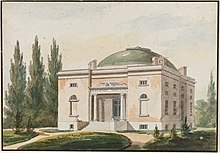
PAFA's 1806 building, in an 1809 engraving.
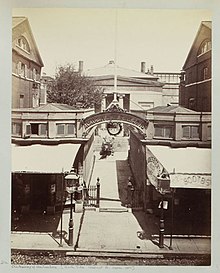
PAFA'south 1845 edifice, in a ca.1870 photograph.
The Pennsylvania University of the Fine Arts was founded in 1805 past painter and scientist Charles Willson Peale, sculptor William Blitz, and other artists and business leaders.[five] The growth of the University of Fine Arts was slow. For many years it held its exhibitions in an 1806 building, designed by John Dorsey with pillars of the Ionic society. It stood on the site of the later American Theater at Chestnut and tenth streets. The academy opened every bit a museum in 1807 and held its starting time exhibition in 1811, where more 500 paintings and statues were displayed. The first school classes held in the building were with the Lodge of Artists in 1810.
The university had to be reconstructed afterwards the burn of 1845. Some 23 years later on, leaders of the academy raised funds to construct a building more than worthy of its treasures. They deputed the current Furness-Hewitt building, which was constructed from 1871. Information technology opened every bit part of the 1876 Philadelphia Exposition.[half-dozen]
In 1876, former academy student and artist Thomas Eakins returned to teach as a volunteer. Fairman Rogers, chairman of the Commission on Pedagogy from 1878 to 1883, made him a faculty member in 1878, and promoted him to director in 1882. Eakins revamped the certificate curriculum to what information technology used to be today. Students in the document plan learned fundamentals of drawing, painting, sculpture, and printmaking (relief, intaglio, and lithography) for ii years. For the next two years, they had conducted independent study, guided by frequent critiques from faculty, students, and visiting artists.
From 1811 to 1969, the academy organized important annual art exhibitions, from which the museum made significant acquisitions. Harrison Due south. Morris, managing managing director from 1892 to 1905, collected contemporary American art for the institution. Among the many masterpieces acquired during his tenure were works past Cecilia Beaux, William Merritt Hunt, Frank Duveneck, Thomas Eakins, Winslow Homer, Childe Hassam, and Edmund Tarbell. Work by The 8, which included former Academy students Robert Henri and John Sloan, is well represented in the collection. It provides a transition between 19th- and 20th- century art movements.
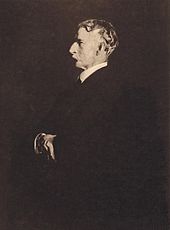
From 1890 to 1906, Edward Hornor Coates served equally the tenth president of the academy. In 1915, Coates was awarded the university's gold medal.[7] Painter John McLure Hamilton, who began his art instruction at the university nether Thomas Eakins, in 1921 described the contributions Coates fabricated during his tenure:
The reign of Mr. Coates at the University marked the period of its greatest prosperity. Rich endowments were made to the schools, a gallery of national portraiture was formed, and some of the best examples of Gilbert Stuart's work caused. The annual exhibitions attained a brilliancy and éclat hitherto unknown ... Mr. Coates wisely established the schools upon a conservative basis, building nigh unconsciously the dykes high against the oncoming flow of insane novelties in art patterns ... In this last struggle against modernism the President was ably supported by Eakins, Anschutz, Grafly, [Henry Joseph] Thouron, Vonnoh, and Hunt ... His unfailing courtesy, his disinterested thoughtfulness, his tactfulness, and his modesty endeared him to scholars and masters alike. No cede of fourth dimension or of means was besides great, if he thought he could accomplish the end he e'er had in view—the honour and the glory of the Academy. It was under Mr. Coates' aware direction that was fulfilled the expressed wish of Benjamin West, the start honorary Academician, that "Philadelphia may be as much historic for her galleries of paintings by the native genius of the state, equally she is distinguished by the virtues of her people; and that she may be looked up to as the Athens of the Western Earth in all that can give shine to the homo heed."[8]
During World War I, university students were actively involved in state of war work. "About threescore percent of the young men enlisted or entered Government service, and probably all of the young women and all the residual of the young men were directly or indirectly engaged in war work."[9] A state of war service society was formed past students and a monthly publication, The Academy Fling, was sent to service members. George Harding, a former PAFA student, was commissioned captain during the war and created official gainsay sketches for the American Expeditionary Forces.
Women at the Academy [edit]
The 1844 Board of Directors' annunciation that women artists "would take exclusive use of the statue gallery for professional purposes" and report time in the museum on Monday, Midweek, and Friday mornings signified a significant accelerate towards formal grooming in fine art for women.[10] Prior to the founding of the university, there were limited opportunities for women to receive professional art training in the United states. This menses betwixt the mid-19th and early 20th centuries shows a remarkable growth of formally trained women artists.
Past 1860 female students were allowed to take anatomy and antique courses, drawing from antique casts.[eleven] In improver, women enjoyed their newly acquired library and gallery admission. Life classes, the written report of the nude body, were available to women in the spring of 1868 with female person models; male models were added for study six years later. This came after much fence on whether it was appropriate for women to view the nude male form.
Information technology took 24 years before women could accept total advantage of all aspects of training at the prestigious institution.[12] After 1868 women took more than active leadership roles and accomplished influential positions. For case, in 1878 Catherine Drinker, at the age of 27, became the kickoff adult female to teach at the academy.[13] Ane of her pupils, her younger cousin Cecilia Beaux, would go out a lasting legacy at the academy as the outset female faculty fellow member to instruct painting and drawing, beginning in 1895.[14] By the 1880s women artists competed with men for top accolades and recognition. Not until much later, however, did the academy proceeds its starting time woman on the board of directors in 1950.
Even as women artists were making progress in the United States, they had difficulty studying in Europe. Many of the famous and land-run academies, such as the École des Beaux-Arts in Paris, actively excluded women until the late 19th century, and many of the but opportunities available were through privately run, less prestigious art schools or ateliers of artists.[xv] Women who chose to travel overseas typically studied the works of master artists in the galleries, not in classes.[ citation needed ]
In 2010, the academy acquired the Linda Lee Alter Collection of Fine art by Women, nearly 500 works by female person artists, from collector Linda Lee Alter. Artists in the collection include those of international renown, such every bit Louise Bourgeois, Judy Chicago, Louise Nevelson, Kiki Smith and Kara Walker, as well renowned Philadelphia artists including Elizabeth Osborne. In 2012, the academy featured the collection in the exhibition The Female Gaze: Women Artists Making Their Globe. [15]
The Academy today [edit]

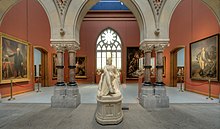
The Museum [edit]
Since its founding, the academy has nerveless works by leading American artists, also equally works past distinguished alumni and faculty of its school. Today, the academy maintains its collecting tradition with the inclusion of works past mod and gimmicky American artists. Acquisitions and exhibition programs are balanced betwixt historical and contemporary art, and the museum continues to evidence works past contemporary regional artists and features annual displays of work by academy students. The collection is installed in a chronological and thematic format, exploring the history of American fine art from the 1760s to the nowadays.
The Schoolhouse [edit]
The academy was well known for its longstanding four-year certificate program. Since 1929, qualified students take been able to apply for and receive a coordinated Available of Fine Arts program at the Academy of Pennsylvania. Some other BFA degree program is offered exclusively in-house (a recent addition) its Master of Fine Arts programme, a Post Baccalaureate Document in Graduate Studies, and extensive standing education offerings, likewise as programs for children and families.
In 2005, the academy received the National Medal of Arts recognizing it equally a leader in fine arts teaching.[2]
In January 2007, the academy, in association with the Philadelphia Museum of Art, purchased Thomas Eakins's piece of work The Gross Dispensary from the Jefferson Medical School.[ commendation needed ] This seminal American piece of work will be displayed at both institutions on a rotating basis.
In January 2009, PAFA signed a historic transfer agreement with Camden County College, New Jersey.[16] The "Camden Connexion" allows for the transfer of liberal arts and studio classes as well every bit providing, on a competitive footing, for partial merit scholarships specifically for Camden County College students. Other transfer agreements are now in place with the following community higher art departments:[ citation needed ] Customs Higher of Philadelphia, Montgomery County Community College, Atlantic Cape Community Higher, and Northampton Community Higher.
In 2013, PAFA received Centre States Commission on Higher Education accreditation. PAFA had offered a major in the Certificate and the Bachelor of Fine Arts Program. Starting in Summertime 2015, PAFA began offering a depression-residency Master of Fine Arts program. Since Autumn 2015, PAFA has offered courses in fine arts analogy, which complements painting, drawing, printmaking, and sculpture courses.
Buildings [edit]

The Furness-Hewitt edifice in 1965
The Furness-Hewitt building [edit]
The current museum building began construction in 1871 and opened in 1876 in connection with the Philadelphia Centennial. Designed by the American architects Frank Furness and George Hewitt, it has been called "1 of the near magnificent Victorian buildings in the country."[half-dozen] The building's façade draws from a number of dissimilar historical styles, including 2d Empire, Renaissance Revival and Gothic Revival, amalgamated in an "aggressively personal manner".[6] The edifice's exterior coloration combines "rusticated brownstone, dressed sandstone, polished pink granite, red pressed brick, and purplish terra-cotta."[6]

Interior of the Furness-Hewitt building
The inside of the edifice is equally varied, combining "gilt floral patterns incised on a field of Venetian red; ... [a] cerulean blue ceiling sprinkled with silver stars", and plum, ochre, sand and olive green gallery walls. The building's structure combines brick, stone and iron; because of fire-proofing concerns, some of the fe i-beams were left uncovered.[6]
- 1876 opening notes:
The newly-built University of Fine Arts volition acquit comparison with any establishment of its kind in America. It has a front of 1 hundred feet on Broad Street and a depth of two hundred and fifty-eight feet on Cherry Street. Its situation, with a street on each of its iii sides, and an open space along a considerable portion of the fourth, is very advantageous as regards lighting, and freedom from risk by burn down.
Information technology is built of brick, the principal entrance, which is ii stories high, beingness augmented with encaustic tiles, terra-cotta statuary, and light stone dressings. The walls are laid in patterns of ruby and white brick. Over the principal entrance on Broad Street there is a large Gothic window with stone tracery. The Red Street front is relieved past a colonnade supporting arched windows, dorsum of which is the transept and pointed gable.
Across the entrance vestibule is the main staircase, which starts from a wide hall and leads to the galleries on the second floor. Forth the Ruby Street side of the Academy are five galleries arranged for casts from the antique; and, further on, are rooms for drapery painting, and the life class. These accept a clear northward light which tin never exist obstructed.
On the south side, in that location is a large lecture room, with retiring rooms, and back of these are the modeling rooms and rooms devoted to the use of students and professors.
On the second flooring is the principal hall, which extends beyond the building, and is intended for the exhibition of big works of art. This story is divided into galleries, which are lighted from the elevation. Through the eye runs a hall which is gear up apart for the exhibition of statuary, busts, small-scale statues, bas-reliefs, etc. On each side of this hall are picture galleries, which are so arranged in size and course every bit to admit of classification of pictures, and which can exist divided into suits where split up exhibitions may be held at the same fourth dimension.
The art collections of the gallery are considered the most valuable in America. They incorporate the masterpieces of Stuart, Sully, Allston, West, and others of our early artists, the Gilpin gallery, fine marbles, and facsimiles of famous statues, too as a magnificent gallery from the antique.[17]
The academy edifice is Furness's best known work, and served to found him as one of the state'due south top architects.[18] Despite existence initially praised by critics, by the plow of the century, tastes had changed and the building was not considered appealing. Eventually, steps were taken to obscure its ornamentation to "modernize" it.
In the postal service-World War II era, the edifice was newly appreciated again, with the growth in the historic preservation move making people more aware of treasures from the by. The building is now considered a masterpiece, one of the greatest buildings in Philadelphia and arguably Furness's greatest piece of work. The building was listed on the National Register of Celebrated Places in 1971 and designated a National Historic Landmark in 1975.[nineteen] In 1976 the building was fully restored, both its interiors and exteriors, to coincide with its centennial and with the United States bicentennial. The restoration work was conducted through Day and Zimmerman Associates, and headed past Human Myers.[xx]
Samuel K.Five. Hamilton Building [edit]
In 2002, Dorrance H. Hamilton made a large donation to the academy for its expansion. It purchased the old automobile factory at 128 N. Wide Street, next to the original building. Designed by Charles Oelschlager, the edifice had formerly been used as a federal building.[ citation needed ]
The structure was renamed in retention of her husband, Samuel M.V. Hamilton. It was renovated and the School of Fine Arts of the university completed its move there in September 2006. The building as well contains a special exhibition infinite called the Fisher Brooks Gallery, named afterwards James R. Fisher, an creative person who attended PAFA in the late 1880s, and Leonie Brooks. They are the grandfather and mother, respectively, of Marguerite Lenfest, a philanthropist and PAFA board member. The Hamilton edifice likewise houses Portfolio, the museum's gift store.
Notable people [edit]
Notable Academy students, faculty and leaders include:
- Linda Lee Alter
- Charles Andes
- Thomas Pollock Anshutz
- Thomas N. Armstrong III
- Elizabeth Gowdy Bakery
- Will Barnet
- Cornelia Barns
- Bo Bartlett
- Walter Emerson Baum
- Anna Whelan Betts
- Ethel Franklin Betts
- Cecilia Beaux
- Alexander Stirling Calder
- Al Capp (attended briefly)
- Arthur B. Carles
- Mary Cassatt
- Jonathan Lyndon Chase
- Margaret Covey Chisholm
- Edward Hornor Coates
- Rachel Constantine
- Colin Campbell Cooper
- John Rogers Cox[21]
- Ralston Crawford
- Jack Delano
- Vincent Desiderio
- Blanche Dillaye
- Thomas Eakins
- Thomas Harlan Ellett, builder
- David Em
- Wharton Esherick
- Stephen Etnier
- Virginia B. Evans
- Frances Farrand Dodge
- Louise Fishman
- A. B. Frost
- Frank Furness
- Charles Lewis Fussell
- Daniel Garber
- William Glackens
- Charles Grafly
- Marie Bruner Haines
- William Weeks Hall[22]
- Walker Hancock
- James Havard
- A. Thousand. Heaton
- Barkley Hendricks
- Robert Henri
- Edward Lamson Henry
- George Hewitt
- Thomas Hovenden
- Frances Tipton Hunter
- Elsa Jemne
- Maria Louise Kirk[23]
- Christine Lafuente
- Sara Larkin
- Dorothy P. Lathrop
- Frank B. A. Linton
- Adelia Armstrong Lutz
- David Lynch
- Paul Manship
- John Marin
- Don Martin
- Donald Martiny
- Elise Mercur, architect
- James Metcalf
- Alme Meyvis
- Katherine Milhous
- Abram Molarsky
- Edward Percy Moran
- Alphonse Mucha
- Taras Mychalewych
- John Neagle
- Alice Neel
- Brad Neely
- Roy Cleveland Nuse
- Violet Oakley
- Elizabeth Osborne
- Maxfield Parrish
- Charles Willson Peale
- Rembrandt Peale
- Clara Elsene Peck
- Louise Pershing
- Jane Piper
- Albin Polasek
- Howard Pyle
- Jacques Reich
- Seymour Remenick
- Fairman Rogers
- Peter F. Rothermel
- William Rush
- Lawrence Saint
- William Sartain
- Mary B. Schuenemann
- Leopold Seyffert
- Michael H. Shamberg[24]
- David Sherman
- Everett Shinn
- John French Sloan
- Owen Staples
- LeConte Stewart
- Frank Wilbert Stokes
- Henry O. Tanner
- Ellen Powell Tiberino
- William B. T. Trego
- Orlando Grey Wales
- Philip Fishbourne Wharton
- Benjamin West
- Anita Willets-Burnham
Awards presented to individuals by the academy [edit]
- Widener Golden Medal: The academy established the George D. Widener Gold Medal for sculpture in 1912. Widener was a businessman and director of the academy who died on the RMS Titanic. The award recognizes the "most meritorious work of Sculpture modeled by an American citizen and shown in the Almanac Exhibition".[25]
Defunct awards [edit]
- Brook Gold Medal: The Ballad H. Beck Golden Medal was awarded to the best portrait past an American creative person exhibited at PAFA'south annual exhibition. It was awarded from 1909 to 1968.
- Mary Smith Prize: The Mary Smith Prize was awarded to "the Painter of the all-time painting (not excluding portraits) exhibiting at the University, painted past a resident adult female Artist."[26] It was awarded from 1879 to 1968.
- Temple Gold Medal: The Joseph Temple Fund Gold Medal was awarded to the best oil painting past an American artist exhibited at PAFA's almanac exhibition. It was awarded from 1883 to 1968.
Deaccessioning [edit]
In 2013, the academy sold East Wind Over Weehawken (1934), 1 of two Edward Hopper paintings in its collection, to beginning an endowment fund. About 25 pct of the fund will exist used to fill gaps in the drove of historic fine art, with much of the remainder to purchase contemporary art of undetermined value with hopes for dramatic increases in the future.[27] The painting was sold at auction for $forty,485,000,[28] assuasive a substantial heave to the museum'south then-current endowment of nigh $23.5 million,[29] merely raised new questions virtually the museum's mission and whether such deaccessionings are in the public interest.
See also [edit]
-
 Philadelphia portal
 - Listing of National Historic Landmarks in Philadelphia
- National Register of Historic Places listings in Center Urban center, Philadelphia
References [edit]
Notes
- ^ "National Register Information System". National Register of Celebrated Places. National Park Service. Jan 23, 2007.
- ^ a b "Pennsylvania Academy of the Fine Arts: About". Artinfo. 2008. Retrieved 2008-07-24 . [ permanent expressionless link ]
- ^ "PHMC Historical Markers". Historical Marker Database. Pennsylvania Historical & Museum Committee. Archived from the original on December seven, 2013. Retrieved December 10, 2013.
- ^ a b "Pennsylvania Academy of the Fine Arts", Encyclopedia Britannica, Retrieved 28 July 2018.
- ^ "History of PAFA", Pennsylvania Academy of Fine Arts, Retrieved 28 July 2018.
- ^ a b c d due east Gallery, John Andrew, ed. (2004), Philadelphia Compages: A Guide to the City (2nd ed.), Philadelphia: Foundation for Architecture, ISBN0962290815 , p. 65
- ^ American Fine art News (January 7, 1922)
- ^ Hamilton, John McLure. Men I Have Painted. London: T. Fisher Unwin Ltd., 1921; p. 176-180
- ^ Philadelphia in the World War: 1914–1919, New York: Wynkoop Hallenbeck Crawford Co., 1922. pg. 517
- ^ The Pennsylvania Academy and Its Women, pg. 12
- ^ May, Stephen, "An Indelible Legacy: The Pennsylvania Academy of Fine Arts, 1805–2005" in Hain, Mark et al. Pennsylvania Academy of the Fine Arts, 1805–2005: 200 years of Excellence Philadelphia, PA: Pennsylvania Academy of the Fine Arts, 2005, pg.sixteen
- ^ The Pennsylvania Academy and Its Women, pg. 17
- ^ The Pennsylvania Academy and Its Women, pg.19
- ^ Yount, Sylvia et al. Cecilia Beaux: American Figure Painter, Atlanta: High Museum of Art; Berkeley: University of California Press, 2007, pg. 36
- ^ a b Pennsylvania Academy of the Fine Arts; Cozzolino, Robert (2012-01-01). The female gaze: women artists making their world. ISBN9781555953898. OCLC 810442369.
- ^ PAFA To Offer Scholarships to Fine Arts Students at Camden County College, PAFA Press Room, 2/20/2009
- ^ Strahan, Edward, ed. (1875). A Century After, picturesque glimpses of Philadelphia and Pennsylvania. Philadelphia: Allen, Lane & Scott and J. Westward. Lauderbach.
- ^ Teitelman, Edward & Longstreth, Richard W. (1981), Architecture in Philadelphia: A Guide, Cambridge, Massachusetts: MIT Press, ISBN0262700212 , p. 80
- ^ Webster, Richard J. (1976). Philadelphia Preserved. Philadelphia, PA: Temple Academy Press. pp. 136–137.
- ^ Moss, Rodger (2008). Celebrated Landmarks of Philadelphia. Philadelphia, PA: Academy of Philadelphia Press. pp. 186–191.
- ^ John Rogers Cox: Depository financial institution clerk wins fame painting wheat fields. Life Magazine. July 12, 1948. Retrieved 2012-12-nineteen .
- ^ "William Weeks Hall Has A Final Resting Place At The Shadows". Newspapers.com. The Daily Advertiser. 27 June 1961. p. 9. Retrieved 2021-05-22 .
{{cite web}}: CS1 maint: url-condition (link) - ^ "Kirk, Maria Louise" in Dorothy B. Gilbert (ed.), Who's Who in American Fine art (New York: R. R. Bowker Co. 1970), p. 123
- ^ Kaltenbach, Chris (2014-11-fifteen). "Remembrance: Michael Shamberg, from Baltimore to New Guild and beyond". Baltimore Dominicus . Retrieved 2014-eleven-29 .
- ^ Catalogue of the almanac exhibition, Volume 112 By Pennsylvania Academy of the Fine Arts
- ^ Pennsylvania Academy of the Fine Arts (1919). Catalogue of the Annual Exhibition. Philadelphia: Pennsylvania University of the Fine Arts. p. 6.
- ^ Graham Bowley (August 27, 2013), Pennsylvania Museum Selling a Hopper to Raise Endowment for Contemporary Art New York Times.
- ^ "Christie'southward Auction Results, Sale 2750, Lot 17" Christie's (December v, 2013)
- ^ Spiegelman, Willard. "University at a Crossroads" Wall Street Journal (September 25, 2013)
Bibliography
- The Pennsylvania University and its women, 1850–1920: May 3 – June xvi, 1974 Pennsylvania Academy of the Fine Arts, Philadelphia, Pennsylvania (exhibition catalogue). Philadelphia, PA: Pennsylvania Academy of the Fine Arts, 1974.
- Pennsylvania University of Fine Arts. In This University: The Pennsylvania Academy of the Fine Arts, 1805–1976. Museum Press, Inc: Washington, D.C., 1976.
External links [edit]
- Official website

- The original University of the Fine Arts, 1869 at the Historical Society of Pennsylvania
- The University of the Fine Arts and Its Future: address delivered before the Art Club of Philadelphia by Edward H. Coates (24 January 1890)
- National Annals Nomination on the National Park Service website
- HABS Documentation on Library of Congress website
- Philadelphia Architects and Buildings list of the university building
0 Response to "Pennsylvania Academy of the Arts Foyer Pennsylvania Academy of the Arts Entrance"
Post a Comment