Why Was Italy and to More Detailed Extent Venice and Florence Primed for Funding the Arts
Affiliate 3: The Renaissance
The Renaissance, meaning "rebirth," was a catamenia of innovation in culture, art, and learning that took place between the fourteenth and sixteenth centuries, starting in Italia then spreading to various other parts of Europe. Information technology produced a number of artists, scientists, and thinkers who are still household names today: Michelangelo, Leonardo Da Vinci, Donatello, Botticelli, and others. The Renaissance is justly famous for its achievements in fine art and learning, and even though some of its thinkers were somewhat conceited and off-base in dismissing the prior g years or so as being goose egg but the "Dark Ages," it is nevertheless the case that the Renaissance was enormously fruitful in terms of intellectual production and creation.
"The" Renaissance lasted from about 1300 – 1500. It concluded in the early sixteenth century in that its northern Italian heartland declined in economic importance and the pace of change and progress in the arts and learning slowed, but in a very existent sense the Renaissance never truly ended – its innovations and advances had already spread across much of Europe, and even though Italian republic itself lost its prominence, the patterns that began in Italian republic continued elsewhere. That was truthful non merely of art, but of pedagogy, architecture, scholarship, and commercial practices.
The timing of the Renaissance coincided with some of the crises of the Eye Ages described in the last chapter. The overlap in dates is explained by the fact that most of Europe remained resolutely "medieval" during the Renaissance'southward heyday in Italy: the means of life, forms of technology, and political construction of the Centre Ages did not suddenly alter with the flowering of the Renaissance, non least because information technology took and so long for the innovations of the Renaissance to spread beyond Italy. Also, in Italy itself, the lives of near people (specially outside of the major cities) were all but identical in 1500 to what they would accept been centuries before.
Background
Simply put, the background of the Renaissance was the prosperity of northern Italia. Italy did not face a major, ongoing series of wars like the Hundred Years' War in French republic. Information technology was striking hard by the plague, only no more and then than well-nigh of the other regions of Europe. 1 unexpected "benefit" to Italy was actually the Babylonian Captivity and Great Western Schism: considering the popes' authority was so express, the Italian cities plant it easy to operate with trivial papal interference, and powerful Italian families frequently intervened directly in the election of popes when information technology suited their interests. Likewise, the other powers of Europe either could not or had no interest in troubling Italy: England and France were at war, the Holy Roman Empire was weak and fragmented, and Spain was not united until the late Renaissance catamenia. In short, the crises of the Centre Ages actually benefited Italia, because they were centered elsewhere.
In this relatively stable social and political environs, Italia also enjoyed an advantage over much of the residue of Europe: it was far more urbanized. Considering of its location as a crossroads betwixt east and west, Italian cities were larger and in that location were merely more of them as compared to other kingdoms and regions of Europe, with the concomitant economic prosperity and sophistication associated with urban life. By 1300, northern Italian republic boasted twenty-three city-states with populations of 20,000 or more, each of which would have constituted an enormous metropolis past medieval standards.
Italian cities, clustered in the north, represented nearly ten% of Italian republic's overall population. While that means that xc% of the population was either rural or lived in small towns, there was nonetheless a far greater concentration of urban dwellers in Italia than anywhere else in Europe. Amongst those cities were also several that boasted populations of over 100,000 by the fifteenth century, including Florence and Milan, which served as centers of banking, trade, and craftsmanship. Italian cities had large numbers of very productive craft guilds and workshops producing luxury appurtenances that were highly desirable all over Europe.
Economics
Italy lay at the heart of the lucrative trade betwixt Europe and the Middle Due east, a condition determined both by its geography and the role Italians had played in transporting appurtenances and people during the crusading period. Along with the trade itself, information technology was in Italia that cardinal mercantile practices emerged for the outset fourth dimension in Europe. From the Arab globe, Italian merchants learned about and ultimately adopted a number of commercial practices and techniques that helped them (Italians) stay at the forefront of the European economy equally a whole. For example, Italian accountants adopted double-entry bookkeeping (accounts payable and accounts receivable) and Italian merchants invented the commenda, a way of spreading out the chance associated with business ventures amid several partners – an early course of insurance for expensive and risky commercial projects. Italian banks had agents all over Europe and provided reliable credit and bills of exchange, allowing merchants to travel around the entire Mediterranean region to trade without having to literally cart chests full of coins to pay for new wares.
One other noteworthy innovation first employed in Europe by Italians was the use of Standard arabic numerals instead of Roman numerals, since the former are so much easier to work with (due east.g. imagine trying to do complicated multiplication or division using Roman numerals like "CLXVIII multiplied by XXXVIII," pregnant "168 multiplied by 38" in Arabic numerals…it was simply far easier to introduce errors in calculation using the former). Overall, Italian merchants, borrowing from their Arab and Turkic trading partners, pioneered efforts to rationalize and systematize business itself in order to make it more predictable and reliable.
Benefiting from the fragmentation of the Church during the era of the Babylonian Captivity and the Peachy Western Schism, Italian bankers also came to charge interest on loans, becoming the first Christians to defy the church building's ban on "usury" in an ongoing, regular way. The stigma associated with usury remained, but bankers (including the Medici family unit that came to completely dominate Florentine politics in the fifteenth century) became so wealthy that social and religious stigma alone was not plenty to preclude the spread of the practice. This actually led to more than anti-Semitism in Europe, since the 1 social function played past Jews that Christians had grudgingly tolerated – money-lending – was increasingly usurped by Christians.
Much of the prosperity of northern Italy was based on the trade ties (not just mercantile practices) Italia maintained with the Heart Eastward, which by the fourteenth century meant both the remains of the Byzantine Empire in Constantinople every bit well as the Ottoman Turkish empire, the ascent power in the east. From the Turks, Italians (especially the neat mercantile empire controlled by Venice) bought precious cargo similar spices, silks, porcelain, and coffee, in return for European woolens, crafts, and bullion. The Italians were also the go-betweens linking Asia and Europe by way of the Centre East: Italian republic was the European terminus of the Silk Road.
The Italian city-states were sites of manufacturing as well. Raw wool from England and Spain fabricated its way to Italy to be processed into textile, and Italian workshops produced luxury appurtenances sought subsequently everywhere else in Europe. Italian luxury goods were superior to those produced in the rest of Europe, and shortly even Italian weapons were better-fabricated. Italian farms were prosperous and, past the Renaissance period, produced a significant and ongoing surplus, feeding the growing cities.
1 result of the prosperity generated by Italian mercantile success was the rising of a civilisation of conspicuous consumption. Both members of the nobility and rich non-nobles spent lavishly to brandish their wealth likewise as their culture and learning. All of the famous Renaissance thinkers and artists were patronized by the rich, which was how the artists and scholars were able to concentrate on their work. In turn, patrons expected "their" artists to serve as symbols of cultural accomplishment that reflected well on the patron. The fluorescence of Renaissance art and learning was a outcome of that very specific use of wealth: mercantile and banking riches translated into social and political status through art, architecture, and scholarship.
Political Setting
Even though the western Roman Empire had fallen apart by 476 CE, the great cities of Italy survived in better shape than Roman cities elsewhere in the empire. Likewise, the feudal arrangement had never taken as concord every bit strongly in Italy – in that location were lords and vassals, but especially in the cities there was a large and potent contained class of artisans and merchants who balked at subservience earlier lords, especially lords who did not alive in the cities. Thus, by 1200, most Italian cities were politically independent of lords and came to boss their respective hinterlands, serving every bit lords to "vassal" towns and villages for miles around.
Instead of kings and vassals, power was in the easily of the popoli grossi, literally meaning the "fat people," but here meaning but the rich, noble and non-noble akin. About v% of the population in the richest cities was amidst them. The culture of the popoli grossi was rife with flattery, backstabbing, and politicking, since and so much depended on personal connections. Since noble titles meant less, more depended on one's family unit reputation, and the nearly important thing to the social aristocracy was laurels. Any perceived insult had to be met with retaliation, meaning there was a great deal of bloodshed between powerful families – Shakespeare'southward famous play Romeo and Juliet is set up in Renaissance Italy, featuring rival elite families locked in a blood feud over honor. There was no such thing equally a constabulary force, later on all, just the guards of the rich and powerful and, normally, a urban center guard that answered to the city council. The latter was ofttimes controlled by powerful families on those councils, withal, so both law enforcement and personal vendettas were by and large carried out by private mercenaries.
Another attribute of the identify of the popoli grossi was that, despite their penchant for feuds, they required a peaceful political setting on a large scale in order for their commercial interests to prosper. Thus, they were often hesitant to embark on large-calibration war in Italy itself.
Too, the focus on pedagogy and culture that translated directly into the creation of Renaissance art and scholarship was tied to the identity of the popoli grossi as people of peace: elsewhere in Europe noble identity was still very much associated with war, whereas the popoli grossi of Italy wanted to show off both their mastery of arms and their mastery of thought (forth with their good gustation).
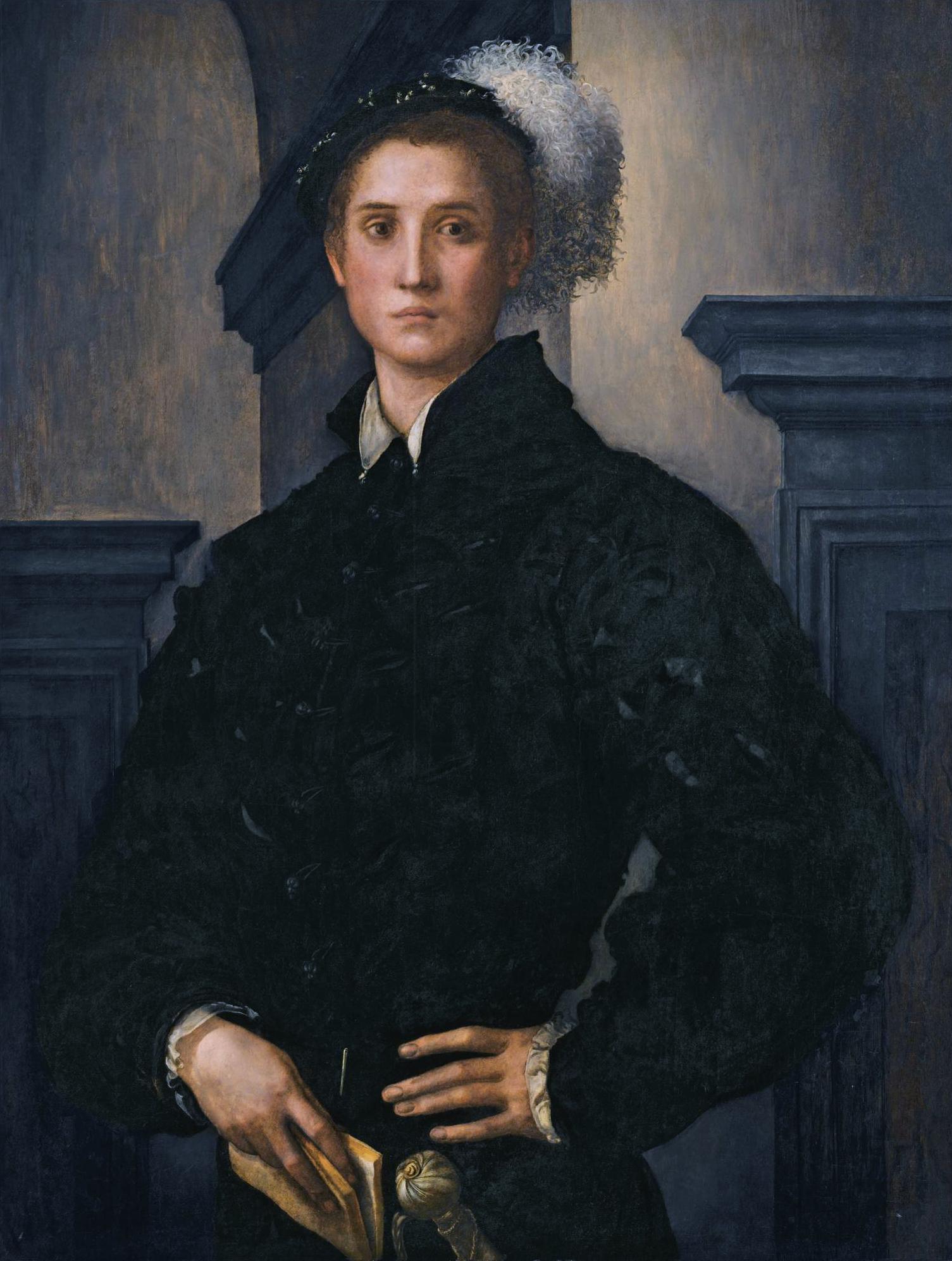
Portrait of a young Cosimo de Medici, who would go the de facto ruler of Florence in the fifteenth century. He is depicted holding a book and wearing a sword: symbols of his learning and his authority.
The fundamental irony of the prosperity of the Renaissance was that even in northern Italy, the vast majority of the population benefited just indirectly or not at all. While the lot of Italian peasants was not significantly worse than that of peasants elsewhere, poor townsfolk had to endure heavy taxes on basic foodstuffs that made it especially miserable to be poor in 1 of the richest places in Europe at the time. A pregnant percent of the population of cities were "paupers," the indigent and homeless who tried to scrape past as laborers or sought charity from the Church. Cities were specially vulnerable to epidemics likewise, adding to the misery of urban life for the poor.
The Peachy City-States of the Renaissance
In the fourteenth and the commencement half of the fifteenth centuries, the urban center-states of northern Italy were aggressive rivals; nigh of the formerly-independent cities were swallowed up by the about powerful amidst them. However, equally the ability of the French monarchy grew in the due west and the Ottoman Turks became an agile threat in the e, the well-nigh powerful cities signed a treaty, the Peace of Lodi, in 1454 which committed each city to the defense of the existing political order. For the next xl years, Italian republic avoided major conflicts, a catamenia that coincided with the height of the Renaissance.
The great city-states of this period were Milan, Venice, and Florence. Milan was the archetypal despot-controlled metropolis-country, reaching its summit under the Visconti family from 1277 – 1447. Milan controlled considerable trade from Italy to the north. Its wealth was dwarfed, still, by that of Venice.
Venice
Venice was ruled by a merchant council headed by an elected official, the Doge. Its Mediterranean empire generated so much wealth that Venice minted more gold currency than did England and France combined, and its gold coins (ducats) were always exactly the same weight and purity and were accepted across the Mediterranean every bit a result. Its government had representation for all of the moneyed classes, but no i represented the majority of the metropolis'due south population that consisted of the urban poor.
The chief source of Venice'southward prosperity was its control of the spice trade. It is hard to overstate the value of spices during the Middle Ages and Renaissance – Europeans had a limitless hunger for spices (as an bated, note that the theory that spices were desirable considering they masked the taste of rotten meat is patently false; medieval and Renaissance-era Europeans did non eat spoiled nutrient). Unlike other luxury goods that could be produced in Europe itself, spices could only be grown in the tropical and subtropical regions of Asia, meaning their transportation to European markets required voyages of many thousands of miles, vastly driving up costs.
The European terminus of much of that trade was Venice. In about 1300 40% of all ships bearing spices offloaded in Venice, and by 1500 it was up to 60%. The prices commanded by spices ensured that Venetian merchants could achieve incredible wealth. For case, nutmeg (grown in Indonesia, halfway around the earth from Italia) was worth a full threescore,000% of its original toll in one case it reached Europe. As well, spices similar pepper, cloves, and cinnamon could only be imported rather than grown in Europe, and Venice controlled the majority of that hugely lucrative merchandise. Spices were, in so many words, worth far more their weight in gold.
Based on that wealth, Venice was the showtime place to create true banks (named afterward the desks, banchi, where people met to exchange or borrow money in Venice). Furthermore, innovations like the letter of credit were necessitated past Venice's remoteness from many of its trade partners; it was too risky to travel with chests full of gold, then Venetian banks were the first to work with messages of credit between branches. A letter of credit could exist issued from one bank branch at a sure amount, redeemable just by the account owner. That individual could then travel to whatever metropolis with a Venetian depository financial institution co-operative and redeem the letter of credit, which could then be spent on trade goods.
In addition, because Venice needed a peaceful trade network for its continuing prosperity, it was the first power in Europe to rely heavily on formal affairs in its relations with neighboring states. By the late 1400s practically every royal court in Europe, the Heart East, and North Africa had a Venetian ambassador in residence. The overall result was that Venice spearheaded many of the practices and patterns that later spread across northern Italy and, ultimately, to the residuum of Europe: the political power of merchants, advanced banking and mercantile practices, and a sophisticated international diplomatic network.
Florence and Rome
Florence was a democracy with longstanding traditions of civic governance. Citizens voted on laws and served in official posts for set terms, with powerful families dominating the organisation. By 1434 the existent ability was in the hands of the Medici family, who controlled the city government (the Signoria) and patronized the arts. Rising from obscurity from a resolutely non-noble groundwork, the Medici eventually became the official bankers to the papacy, acquiring vast wealth as a outcome. The Medici spent huge sums on the city itself, funding the creation of churches, orphanages, municipal buildings, and the completion of the great dome of the city'south cathedral, at the fourth dimension the largest freestanding dome in Europe. They also patronized about of the most famous Renaissance artists (at the time as well equally in the present), including Donatello, Leonardo da Vinci, and Michelangelo.
Florence benefited from a strong civilization of teaching, with Florentines priding themselves not just on wealth, but knowledge and refinement. By the fifteenth century there were eight,000 children in both religious and civic schools out of a population of 100,000. Florentines boasted that even their laborers could quote the not bad poet, and native of Florence, Dante Alighieri (author of The Divine One-act). At the height of Medici, and Florentine, power in the second half of the fifteenth century, Florence was unquestionably the leading metropolis in all of Italy in terms of art and scholarship. That central position macerated by about 1500 equally foreign invasions undermined Florentine independence.
The city of Rome, nevertheless, remained firmly in papal control despite the refuse in independence of the other major Italian cities, having get a major Renaissance metropolis after the end of the Great Western Schism. The popes re-asserted their command of the Papal States in primal Italy, in some cases (like those of Julius II, r. 1503 – 1513) personally taking to the battlefield to lead troops against the armies of both foreign invaders and rival Italians. The popes normally proved effective at secular rule, only their spiritual leadership was undermined by their tendency to live similar kings rather than priests; the nigh notorious, Alexander VI (r. 1492 – 1503), sponsored his children (the infamous Borgia family unit) in their attempts to seize territory all across northern Italy. Thus, even when "adept popes" came along occasionally, the overall design was that the popes did fairly picayune to reinforce the spiritual authority they had already lost because of the Great Western Schism
Regardless of their moral failings, the popes restored Rome to importance as a city after it had fallen to a population of fewer than 25,000 during the Babylonian Captivity. Under the then-called "Renaissance popes," the Vatican itself became the gloriously decorated spectacle that information technology is today. Julius Ii paid Michelangelo to paint the ceiling of the Sistine Chapel in Rome, and many of the other famous works of Renaissance artists stud the walls and facades of Vatican buildings. In curt, popes after the end of the Corking Western Schism were often much more focused on behaving like members of the popoli grossi, fighting for power and honor and patronizing great works of fine art and architecture, rather than worrying about the spiritual authority of the Church building to laypeople.
In general, the Renaissance did not coincide with a nifty period of technological advances. Every bit with all of pre-modern history, the pace of technological change during the Renaissance period was glacially deadening by contemporary standards. There was 1 momentous exception, however: the proliferation of the movable-type press press. Not until the invention of the typewriter in the late nineteenth century and the Net in the tardily twentieth century would comparable changes to the improvidence of information come nigh. Print vastly increased the rate at which data could exist shared, and in turn, it underwrote the ascension in literacy of the early modernistic period. It moved the production of text in Europe abroad from a "scribal" tradition in which educated people hand-copied important texts toward a system of mass-production.
In the centuries leading upwardly to the Renaissance, of form, there had been some major technological advances. The agricultural revolution of the loftier Center Ages had been brought almost by engineering (heavier plows, new harnesses, crop rotation, etc.). Likewise, changes in warfare were increasingly tied to military technology: beginning the introduction of the stirrup, and then everything associated with a "gunpowder revolution" that began in earnest in the fifteenth century (described in a subsequent chapter). Impress, however, introduced a revolution in ideas. By making the distribution of information fast and comparatively cheap, more people had access to that information than ever before. Impress was also an enormous bound frontwards in the long-term view of human technology equally a whole, since the scribal tradition had been in place since the creation of writing itself.
The printing press works by blanket a 3-dimensional impression of an paradigm or text with ink, then pressing that ink onto newspaper. The concept had existed for centuries, first invented in China and used also in Korea and parts of Primal Asia, but there is no bear witness that the concept was transmitted from Asia to Europe (it might have, simply there is simply no proof either way). In the late 1440s, a High german goldsmith named Johannes Gutenberg from the city of Meinz struck on the idea of etching individual messages into small, movable blocks of wood (or casting them in metal) that could exist rearranged as necessary to create words. That innovation, known as movable type, made it viable to print not just a unmarried page of text, but to simply rearrange the messages to print subsequent pages. With movable type, an entire book could exist printed with clear, readable letters, and at a fraction of the cost of hand-copying.
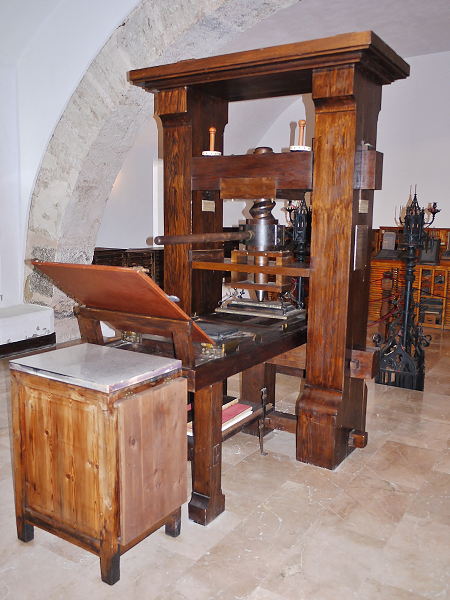
A modernistic replica of a printing printing of Gutenberg'south era.
Gutenberg himself pioneered the European version of the printing procedure. After developing a working prototype, he created the get-go true printed book to accomplish a mass market, namely a copy of the Latin Vulgate (the official version of the Bible used past the Church). After dubbed the "Gutenberg Bible," it became available for purchase in 1455 and in plough became the world'south first "best-seller." One advantage it possessed over hand-written copies of the Bible that speedily became apparent to church officials was that errors in the text were far less likely to be introduced equally compared to hand-copying. Likewise, once new presses were built in cities and towns outside of Meinz, it became cheaper to purchase a printed Bible than i written in the scribal tradition.
Print spread quickly. Inside about xx years at that place were printing presses in all of the major cities in Western and Southern Europe. Gutenberg personally trained amateur printers, who became highly sought-afterward in cities everywhere once the benefits of print became apparent. Past 1500, nearly l years after its invention, the printing press had already largely replaced the scribal tradition in book product (there was a notable lengthy delay in its diffusion to Eastern Europe, particularly Russian federation, notwithstanding – it took until 1552 for a press to come to Russia). Presses tended to operate in large cities and smaller independent cities, especially in the Holy Roman Empire. The free cities of the German lands and Italy were thus as likely to host a press as were larger majuscule cities similar Paris and Rome.
Gutenberg would keep to invent printed illustration in 1461, using carved blocks that were sized to fit alongside movable type. Printed illustration became crucial to the diffusion of information because literacy rates remained low overall; fifty-fifty when people could not read, nonetheless, they could wait at pamphlets and posters (chosen "broadsides") with illustrations. Mere decades later on the invention of the press, cheap printed posters and pamphlets were commonplace in the major cities and towns, oft shared and read aloud in public gatherings and taverns. Thus, fifty-fifty the illiterate enjoyed an increased access to information with print.
Printing had various, and enormous, consequences. Data could exist disseminated far more quickly than always before. Whereas with the scribal tradition, readers tended to hold books in reverence, with the reader having to seek out the book, now books could go to readers. In turn, there was a real incentive for all reasonably prosperous people to acquire to read because they at present had access to meaningful texts at a relatively affordable price. While religious texts dominated early impress, both literary works and political commentaries followed. Overall, impress led to a revolutionary increase in the sheer book of all kinds of written material: in the first fifty years afterwards the invention of the press, more than books were printed than had been copied in Europe by hand since the fall of Rome.
Not all writing shifted to impress, however. A scribal tradition continued in the production of official documents and luxury items. Too, personal correspondence and business transactions remained hand-written, with the legacy of skillful penmanship surviving well into the twentieth century (in part because it was non until the typewriter was invented in the nineteenth century that printed documents could be produced advertizement hoc). Notwithstanding, by the late fifteenth century, whenever a text could be printed to serve a political purpose or to generate a profit, it almost certainly would be.
At that place were other, unanticipated, issues that arose considering of impress. In the past, while the Church did its all-time to crack down on heresies, information technology was not necessary to impose any kind of formal censorship. No written textile could be mass-produced, so the only ideas that spread quickly did so through word of mouth. Print made censorship both much more difficult and much more than of import, since at present anyone could impress only nigh anything. As early as the 1460s, print introduced disruptive ideas in the class of the next best-seller to follow the Bible itself, a piece of work that advocated the pursuit of salvation without reference to the Church entitled The Imitation of Christ. The Church would eventually (in 1571) innovate an official Index of Prohibited Books, but several works were already banned past the time the Alphabetize was created.
While there were other effects of print, one bears particular note: it began the process of standardizing linguistic communication itself. The long, slow shift from a vast panoply of colloquial dialects across Europe to a set of accepted and official languages was impossible without print. Print necessitated that standardization, so that people in unlike parts of "France" or "England" were able to read the same works and understand their grammar and their meaning. For the showtime time, the very concept of proper spelling emerged, and existing ideas about grammar began the process of standardization also.
Patronage
The most memorable, or at least iconic, effects of the Renaissance were creative. To empathize why the Renaissance brought about such a remarkable explosion of fine art, it is crucial to grasp the nature of patronage. In patronage, a member of the popoli grossi would pay an artist in advance for a work of art. That work of art would exist displayed publicly – virtually obviously in the case of architecture with the cute churches, orphanages, and municipal buildings that spread beyond Italia during the Renaissance. In turn, that fine art would concenter political power and influence to the person or family who had paid for it considering of the honor associated with funding the best artists and being associated with their work. While there was enough of bloodshed betwixt powerful Renaissance families, their political competition as often took the form of an ongoing battle over who could commission the all-time art and then "requite" that art to their home city, rather than actual fighting in the streets.
Perchance the most spectacular example of patronage in action was when Cosimo de Medici, so the leader of the Medici family unit and its vast banking empire, threw a city-wide party chosen the Council of Florence in 1439. The Council featured public lectures on Greek philosophy, displays of art, and a huge church quango that brought together representatives of both the Latin Church and the Eastern Orthodox Church in a (doomed) attempt to heal the schism that divided Christianity. The Cosmic hierarchy also used the occasion to establish the canonical and in a sense "final" version of the Christian Bible itself (in question were which books ought to be included in the Old Attestation). The entire affair was paid past Cosimo out of his personal fortune – he fifty-fifty paid for the travel expenses of visiting dignitaries from places as far abroad as Bharat and Ethiopia. The Council clinched the Medici as the family of Florence for the next generation, with Cosimo being described by a contemporary as a "king in all but name."
Art and learning benefited enormously from the wealth of northern Italia precisely because the wealthy and powerful of northern Italy competed to pay for the best fine art and the nigh innovative scholarship – without that form of cultural and political competition, information technology is doubtful that many of the masterpieces of Renaissance art would have ever been created.
Humanism
The starting point with studying the intellectual and artistic achievements of the Renaissance is recognizing what the give-and-take ways: rebirth. Only what was being reborn? The answer is the culture and ideas of classical Europe, namely ancient Greece and Rome. Renaissance thinkers and artists very consciously made the claim that they were reviving long-lost traditions from the classical world in areas every bit diverse equally scholarship, verse, architecture, and sculpture. The feeling amidst most Renaissance thinkers and artists was that the ancient Greeks and Romans had achieved truly incredible things, things that had not been, and maybe could never be, surpassed. Much of the Renaissance began as an endeavor to mimic or copy Greek and Roman art and scholarship (correspondence in classical Latin, for example), but over the decades the more outstanding Renaissance thinkers struck out on new paths of their own – still inspired by the classics, simply seeking to be creators in their own right besides.
Of the various themes of Renaissance thought, maybe the most of import was humanism, an ancient intellectual image that emphasized both the beauty and the centrality of humankind in the universe. Humanists held that humankind was inherently rational, beautiful, and noble, rather than debased, wicked, or weak. They sought to celebrate the beauty of the human body in their art, of the human being listen and homo achievements in their scholarship, and of human gild in the elegance of their architectural design. Humanism was, amongst other things, an optimistic attitude toward artistic and intellectual possibility that cited the achievements of the ancient globe as proof that humankind was the crowning achievement of God'southward cosmos.
Renaissance humanism was the root of some very modern notions of individuality, forth with the thought that education ought to arrive at a well-rounded individual. The goal of didactics in the Renaissance was to realize as much of the human potential as possible with a robust teaching in various disciplines. This was a true, meaningful change over medieval forms of learning in that education'due south major purpose was no longer believed to be the clarification of religious questions or meliorate intellectual support for religious orthodoxy; the point of education was to create a more competent and well-rounded person instead.
Along with the idea of a well-rounded private, Renaissance thinkers championed the idea of civic humanism: one's moral and ethical continuing was tied to devotion to one's city. This was a Greek and Roman concept that the bully Renaissance thinker Petrarch championed in detail. Hither, the Medici of Florence are the ultimate case: at that place was a tremendous endeavour on the part of the rich and powerful to invest in the city in the grade of building projects and art. This was tied to the prestige of the family, of course, but it was also a heartfelt dedication to ane'due south home, analogous to the present-day concept of patriotism.
Practically speaking, in that location was a shift in the practical business of didactics from medieval scholasticism, which focused on law, medicine, and theology, to disciplines related to business and politics. Princes and other elites wanted skilled bureaucrats to staff their merchant empires; they needed literate men with a noesis of law and mathematics, even if they themselves were non merchants. Metropolis governments began educating children (girls and boys alike, at least in sure cities like Florence) directly, forth with the role played by private tutors. These schools and tutors emphasized practical teaching: rhetoric, math, and history. Thus, one of the major effects of the Italian Renaissance was that this new form of pedagogy, usually referred to as "humanistic education" spread from Italy to the rest of Europe past the late fifteenth century. Past the sixteenth century, a broad cross-section of European elites, including nobles, merchants, and priests, were educated in the humanistic tradition.
A "Renaissance human being" (note that there were important women thinkers also, but the term "Renaissance man" was used exclusively for men) was a man who cultivated classical virtues, which were not quite the same equally Christian ones: understanding, benevolence, compassion, fortitude, judgment, eloquence, and honor, amongst others. Drawing from the work of thinkers similar Socrates, Plato, Aristotle, Cicero, and Virgil, Renaissance thinkers came to back up the idea of a virtuous life that was not the aforementioned thing as a specifically Christian virtuous life. And, chiefly, it was possible to get a good person simply through studying the classics – all of the major figures of the Renaissance were Christians, simply they insisted that one's moral condition could and should exist shaped by emulation of the ancient virtues, combined with Christian piety. While the Renaissance case for the debasement of medieval culture was overstated (medieval intellectual life prospered during the late Middle Ages) there was definitely a distinct kind of intellectual backbone and optimism that came out of the render to classical models over medieval ones during the Renaissance.
One important caveat must be included in discussing humanistic didactics, however. While most male humanists supported education for girls, they insisted that it was to be very unlike than that offered to boys. Girls were to read specific texts drawn from the Bible, the "Church Fathers" (important theologians in the early history of the Church), and from classical Greek and Roman writers that emphasized morality, modesty, and obedience. An educated girl was trained to be an obedient, companionable wife, not an independent thinker in her own right. That theme would remain in identify in the male-dominated realm of education in Europe for centuries to come up, although it is clear from the number of contained, intellectually courageous women writers throughout the early on modern period that girls' pedagogy did not always succeed in creating compliant, deferential women in the finish.
Likewise, humanism contributed to an important, ongoing public contend that lasted for centuries: the querelles des femmes ("debates about women"). Between the fifteenth and seventeenth centuries various intellectuals in universities, churches, and aristocratic courts and salons wrote numerous essays and books contesting whether or not women were naturally immoral, weak, and foolish, or if instead educational activity and surround could lead to intelligence and morality comparable with those of men. While men had dominated these debates early, women educated in the humanist tradition joined in the querelles in hostage during the Renaissance, arguing both that education was key to elevating women'due south competence and that women shared precisely the same spiritual and moral nature every bit did men. Unfortunately, while a significant minority of male person thinkers came to agree, most remained adamant that women were biologically and spiritually inferior, destined for their traditional roles and ill-served by advanced educational activity.
Important Thinkers
The Renaissance is remembered primarily for its slap-up thinkers and artists, with some infrequent individuals (like Leonardo da Vinci) being renowned as both. What Renaissance thinkers had in mutual was that they embraced the ideals of humanism and used humanism as their inspiration for creating innovative new approaches to philosophy, philology (the study of language), theology, history, and political theory. In other words, reading the classics inspired Renaissance thinkers to emulate the bang-up writers and philosophers of ancient Hellenic republic and Rome, creating poetry, philosophy, and theory on par with that of an Aristotle or a Cicero. Some of the near noteworthy included the following.
Dante (1265 – 1321)
Durante degli Alighieri, amend remembered simply as Dante, was a major effigy who predictable the Renaissance rather than being alive during most of it (while there is no "official" offset to the Renaissance, the life of Petrarch, described beneath, lends itself to using 1300 every bit a convenient date). Experiencing what would afterward be called a mid-life crisis, Dante turned to poesy to console himself, ultimately producing the greatest written work of the tardily Middle Ages: The Divine Comedy. Written in his own native dialect, the Tuscan of the city of Florence, The Divine One-act describes Dante'southward descent into hell, guided by the spirit of the classical Roman poet Virgil. Dante and Virgil emerge on the other side of the earth, with Dante ascending the mountain of purgatory and ultimately entering heaven, where he enters into the divine presence.
Dante's work, which shortly became justly famous in Italian republic and then elsewhere in Europe, presaged some of the essential themes of Renaissance thought. Dante'due south travels through hell, purgatory, and heaven in the poem are replete with encounters with 2 categories of people: Italians of Dante's lifetime or the recent past, and both real and mythical figures from aboriginal Hellenic republic and Rome. In other words, Dante was indifferent to the entire period of the Middle Ages, concentrating instead on what he imagined the spiritual fate of the bully thinkers and heroes of the classical age would have been (and gleefully relegating Italians he hated to infernal torments). Ultimately, his work became so famous that it established Tuscan as the basis of what would eventually become the language of "Italian" – all educated people in Italia would eventually come up to read the One-act every bit a matter of course and information technology came to serve every bit the founding document of the modern Italian language in the process.
Petrarch (1304 – 1374)
Francesco Petrarca, known as Petrarch in English language, was in many ways the founding father of the Renaissance. Similar Dante, he was a Florentine (native of the city of Florence) and single-handedly spearheaded the practice of studying and imitating the smashing writers and thinkers of the past. Petrarch personally rediscovered long-lost works past Cicero, widely considered the greatest author of ancient Rome during the republican period, and set about grooming himself to emulate Cicero's rhetorical way. Petrarch wrote to friends and associates in a classical, grammatically spotless Latin (every bit opposed to the frequently sloppy and error-ridden Latin of the Middle Ages) and encouraged them to learn to emulate the classics in their writing, thought, and values. He went on to write many works of poetry and prose that were based on the model provided past Cicero and other aboriginal writers.
Petrarch was responsible for coming upwards with the very thought of the "Dark Ages" that had separated his own era from the greatness of the classical past. His ain verse and writings became then popular among other educated people that he deserves a smashing deal of personal credit for sparking the Renaissance itself; following Petrarch, the idea that the classical earth might be "reborn" in northern Italian republic acquired a great deal of popularity and cultural forcefulness.
Christine de Pizan (1364 – 1430)
Christine de Pizan was the most famous and important adult female thinker and writer of the Renaissance era. Her father, the court astrologer of the French king Charles Five, was exceptional in that he felt it important that his daughter receive the aforementioned quality of education afforded to aristocracy men at the fourth dimension. She went on to become a famous poet and author in her own right, existence patronized (i.e. receiving commissions for her writing) by a wide variety of French and Italian nobles. Her best-known piece of work was The Volume of the City of Ladies, in which she attacked the and so-universal idea that women were naturally unintelligent, sinful, and irrational; it was a central text in the querelles des femmes noted above. Instead, she argued, history provided a vast catalog of women who had been moral, pious, intelligent, and competent, and that it was men's pride and the refusal of men to allow women to exist properly educated that held women back. In many means, the Metropolis of Ladies was the first truly feminist piece of work in European history, and information technology is striking that she was supported by, and listened to by, elite men due to her obvious intellectual gifts despite their own deep-seated sexism.
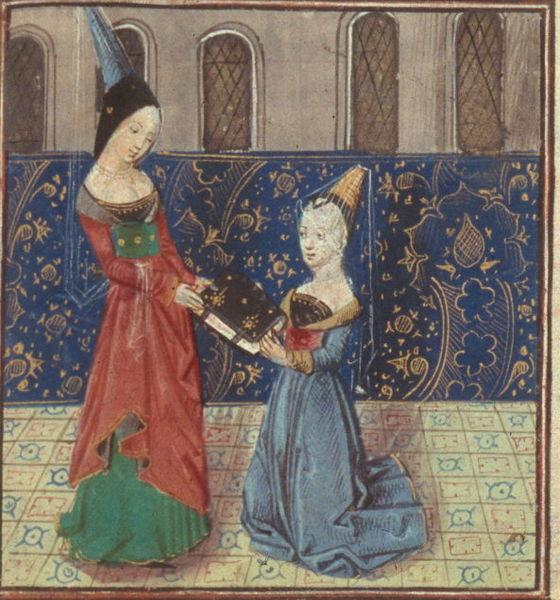
In the analogy above, Christine de Pizan presents a copy of The City of Ladies to a French noblewoman, Margaret of Burgundy. The analogy itself is in the pre-Renaissance "Gothic" style, without linear perspective, despite its gauge date of 1475. This is one example of the relatively ho-hum spread of Renaissance-inspired artistic innovations.
Desiderius Erasmus (1466 – 1536)
Erasmus was an astonishingly erudite priest who benefited from both the traditional scholastic education of the late-medieval church building and the new humanistic style that emerged from the Renaissance. Of his diverse talents, one of the near important was his mastery of philology: the history of languages. Erasmus became completely fluent not simply in classical and medieval Latin, but in the Greek of the New Testament (i.eastward. most of the primeval versions of the New Testament of the Bible are written in the colloquial Greek of the starting time century CE). He also became conversant in Hebrew, which was very uncommon amongst Christians at the time.
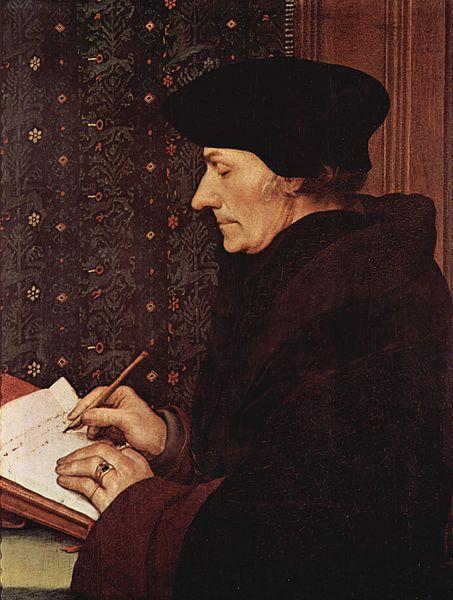
In the above well-known portrait of Erasmus, he is depicted in heavy, fur-lined robes and hat, a necessity even when indoors in Northern Europe for much of the year. Realistic portraiture was another major innovation of the Renaissance period.
Armed with his lingual virtuosity, Erasmus undertook a vast study and re-translation of the New Testament, working from various versions of the Greek originals and correcting the Latin Vulgate that was the most widely used version at the time. In the procedure, Erasmus corrected the New Testament itself, communicable and fixing numerous translation errors (while he did not re-translate the Old Testament from the Hebrew, he did point out errors in it as well).
Erasmus was criticized by some of his superiors inside the Church considering he was not officially authorized to acquit out his studies and translations; nevertheless, he concluded upward producing an extensively notated re-translation of the New Attestation with numerous corrections. Chiefly, these corrections were not merely a question of grammatical issues, but of meaning. The Christian message that emerged from the "right" version of the New Testament was a deeply personal philosophy of prayer, devotion, and morality that did not correspond to many of the structures and practices of the Latin Church. He was also an abet of translations of the Bible into vernacular languages, although he did not produce such a translation himself.
Some of his other works other included In Praise of Folly, a satirical assault on abuse inside the church, and Handbook of the Christian Soldier, which de-emphasized the importance of the sacraments. Erasmus used his abundant wit to ridicule sterile medieval-manner scholastic scholars, the corruption of "Christian" rulers who were essentially glorified warlords, and even the very idea of witches, which he demonstrated relied on a faulty translation from the Hebrew of the Old Testament.
Niccolo Machiavelli (1469 – 1527)
Machiavelli was a "courtier," a professional politician, ambassador, and official who spent his life in the court of a ruler – in his case, every bit part of the city government of his native Florence. While in Florence, Machiavelli wrote various works on politics, most notably a consideration of the proper functioning of a republic similar Florence itself. Unfortunately for him, Machiavelli was caught up in the whirlwind of power politics at court and concluded up being exiled by the Medici.
While in exile, Machiavelli undertook a new work of political theory which he titled The Prince. Hither, Machiavelli detailed how an effective ruler should behave: grooming constantly in war, forcing his subjects to fright (simply not detest) him, studying the aboriginal past for part models like Alexander the Peachy and Julius Caesar, and never wasting a moment worrying near morality when power was on the line. In the procedure, Machiavelli created what was arguably the first work of "political science" that abandoned the moralistic approach of how a ruler should carry equally a good Christian and instead embraced a practical guide to holding ability. He dedicated the work to the Medici in hopes that he would be allowed to render from exile (he detested the rural bumpkins he lived among in exile and longed to return to cosmopolitan Florence). Instead, The Prince acquired a scandal when it came out for completely ignoring the role of God and Christian morality in politics, and Machiavelli died not long after. That being noted, Machiavelli is now remembered as a pioneering political thinker. It is safe to assume that far more rulers accept consulted The Prince for ideas of how to maintain their power over the years than one of the moralistic tracts that was preferred during Machiavelli's lifetime.
Baldassarre Castiglione (1478 – 1529)
Castiglione was the writer of The Courtier, published at the end of his life in 1528. Whereas Machiavelli'southward The Prince was a practical guide for rulers, The Courtier was a guide to the nobles, wealthy merchants, high-ranking members of the Church, and other social elites who served and schemed in the courts of princes: courtiers. The work centered on what was needed to win the prince's favor and to influence him, non just avoiding embarrassment at court. This was tied to the growing sense of what it was to exist "civilized" – Italians at the time were renowned across Europe for their refinement, the quality of their dress and jewelry, their wit in conversation, and their good gustation. The relatively rough tastes of the nobility of the Middle Ages were "revised" starting in Italy, with Castiglione serving equally both a symptom and cause of this shift.
The effective courtier, according to Castiglione, was tasteful, educated, clever, and subtle in his deportment and words, a truthful politico rather than but a warrior who happened to have inherited some land. Going forward, growing numbers of political elites came to resemble a Castiglione-style courtier instead of a thuggish medieval knight or "man-at-arms." When he died, no less a personage than the Holy Roman Emperor Charles V lamented his loss and paid tribute to his memory.
Fine art and Artists
Mayhap the most iconic aspect of the Renaissance as a whole is its tremendous artistic achievements – figures like Leonardo da Vinci and Michelangelo Buonarroti are household names in a mode that Petrarch is non, despite the fact that Petrarch should be credited for creating the very concept of the Renaissance. The fame of Renaissance art is cheers to the incredible inventiveness of the smashing Renaissance artists themselves, who both imitated classical models of art and ultimately forged entirely new creative paths of their own.
Medieval art (called "Gothic" subsequently ane of the Germanic tribes that had conquered the Roman Empire) had been unconcerned with realistic depictions of objects or people. Medieval paintings oftentimes presented things from several angles at in one case to the viewer and had no sense of three-dimensional perspective. Likewise, Gothic architecture tended to exist bulky and overwhelming rather than refined and delicate; the smashing examples of Gothic compages are undoubtedly the cathedrals built during the Middle Ages, often beautiful and inspiring but a far cry from the symmetrical, airy structures of ancient Greece and Rome.
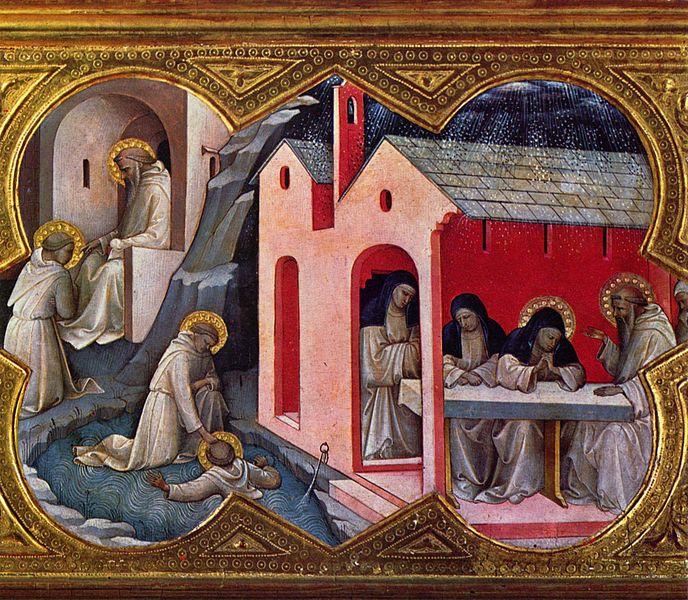
Some other example of Gothic art. The artist, Lorenzo Monaco, painted during the Renaissance period, simply the work was created earlier linear perspective had replaced the "two-dimensional" manner of Gothic painting.
In contrast, Renaissance artists studied and copied ancient frescoes and statues in an effort to learn how to realistically depict people and objects. And, just as Petrarch "invented" the major themes of Renaissance thought by imitating and championing classical humanist thought, a Florentine creative person, architect, and engineer named Filippo Brunelleschi "invented" Renaissance art through the false of the classical earth.
Filippo Brunelleschi (1377 – 1446)
Brunelleschi was an amazing artistic and engineering genius. He became a prominent client of the Medici, and with their political and financial support he undertook the construction of what would be the largest free-standing domed structure in all of Europe: the dome of the cathedral of Florence. For generations, the cathedral of Florence had stood unfinished, its main tower having been congenital too big and too tall for whatever architect to complete. Literally no one knew how to build a freestanding stone dome on height of a belfry over 350 feet high. By studying aboriginal Roman structures and employing his ain incredible intellect, Brunelleschi built the dome in such a way that it held its internal structure together during the construction process. He invented a giant, geared winch to raise huge blocks of sandstone hundreds of feet in the air and was fifty-fifty known to personally ascend the construction to place bricks. The dome was completed in 1413, crowning both his fame as an architect and the Medici's role every bit the greatest patrons of Renaissance art and architecture at the time.
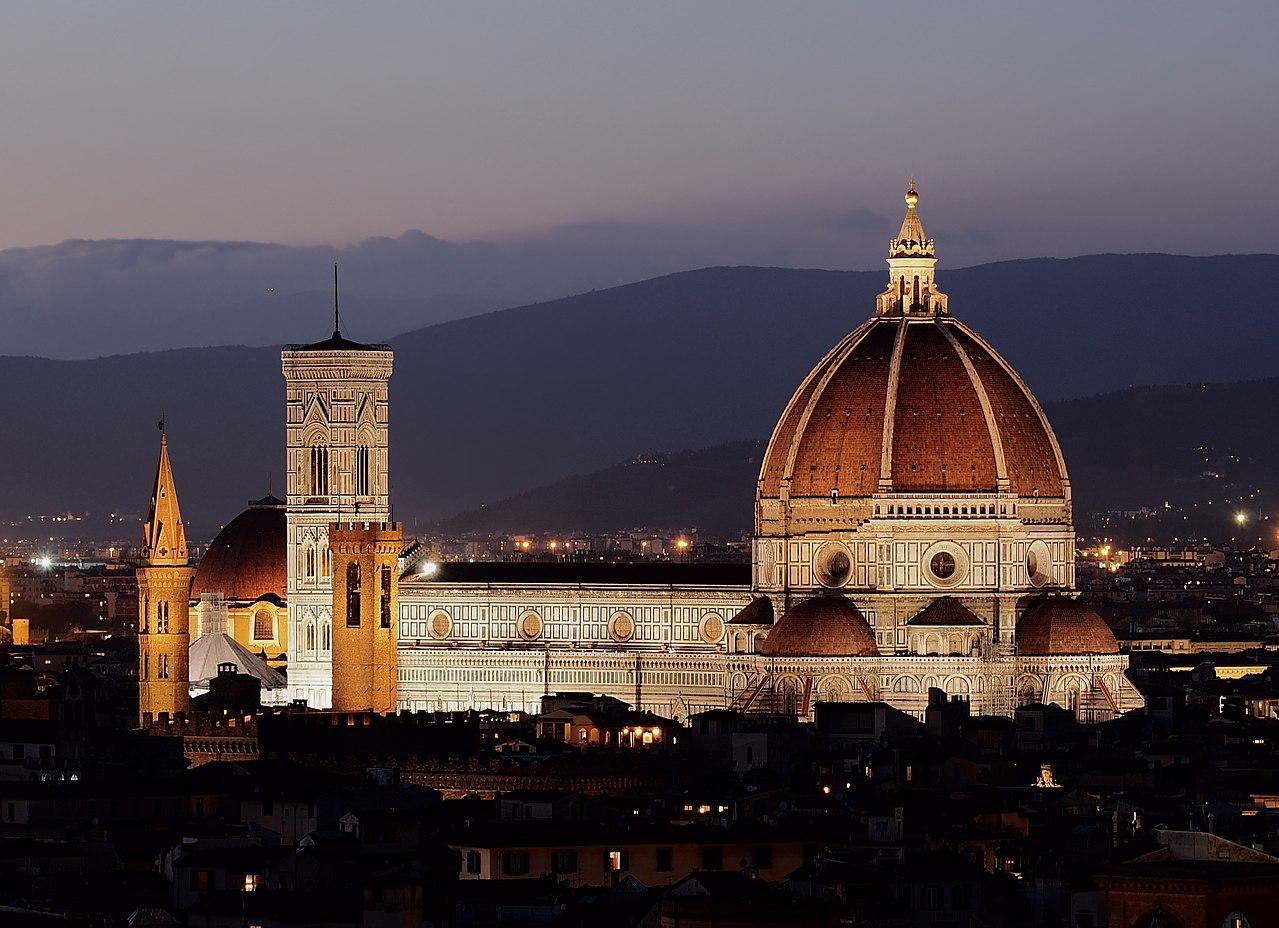
Contemporary photo of the Florence Cathedral, with Brunelleschi'due south dome on the right.
While the dome is usually considered Brunelleschi'south greatest achievement, he was also the (re-)inventor of one of the most important creative concepts in history: linear perspective. He was the beginning person in the Western globe to make up one's mind how to draw objects in ii dimensions, on a piece of paper or the equivalent, in such a way that they looked realistically three-dimensional (i.east. having depth, every bit in looking off into the altitude and seeing objects that are further abroad "look smaller" than those nearby). Here, Brunelleschi was unquestionably influenced by a medieval Arab thinker, Ibn al-Haytham, whose Volume of Eyes laid out theories of light and sight perception that described linear perspective. The Volume of Optics was available to Brunelleschi in Latin translation, and, crucially, Brunelleschi practical the concept of perspective to bodily art (which al-Haytham had not, focusing instead on the scientific basis of optics). In doing so, Brunelleschi introduced the power for artists to create realistic depictions of their subjects. This innovation spread apace and completely revolutionized the visual arts, resulting in far more lifelike drawings and paintings.
Sandro Botticelli (1445 – 1510)
Botticelli exemplified the life of a successful Renaissance painter during the acme of the near productive artistic catamenia in Florence and Rome. Likewise, his works focused on themes central to the Renaissance as a whole: the importance of patronage, the commemoration of classical figures and ideas, the beauty of the homo body and mind, and Christian piety. Botticelli was patronized by diverse members of the Florentine popolo grossi, by the Medici, and by popes, producing numerous frescos (wall paintings done on plaster), portraits, and both biblical and classical scenes. Two of his virtually famous works capture dissimilar aspects of Renaissance fine art:
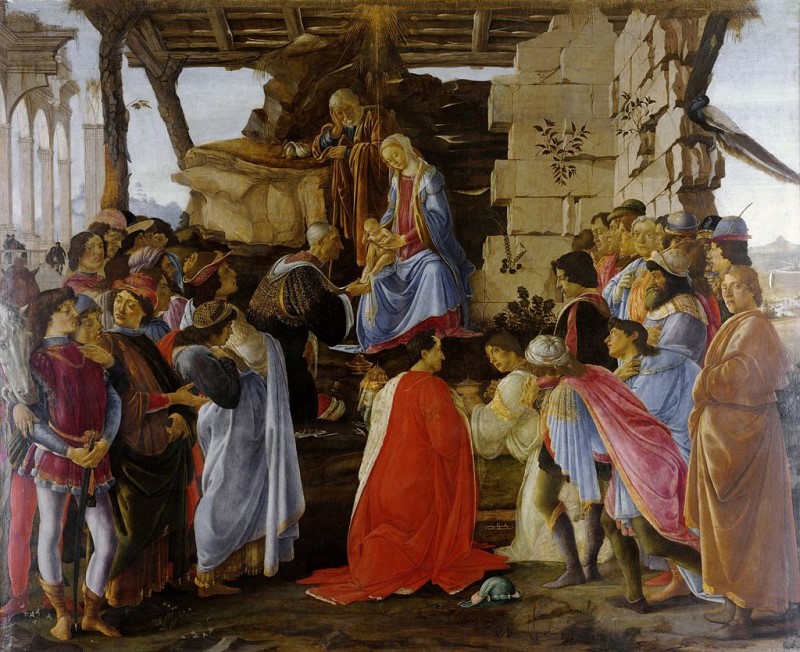
The Adoration of the Magi (1475), above, depicts members of the Medici family, Botticelli's patrons, as taking part in one of the fundamental scenes from the nativity of Christ. Botticelli even included himself in the painting; his cocky-portrait is the figure on the far right. Note how all of the figures are dressed equally wealthy Italians of the fifteenth century, not Jews, Romans, and Persians of the first century. Despite the abundance of biblical scenes in Renaissance painting, no endeavour was made to depict people as they might accept appeared at the time. Instead, the paintings projected the world of the popoli grossi back in fourth dimension, sometimes (as with this example) fifty-fifty including portraits of actual important Italians.
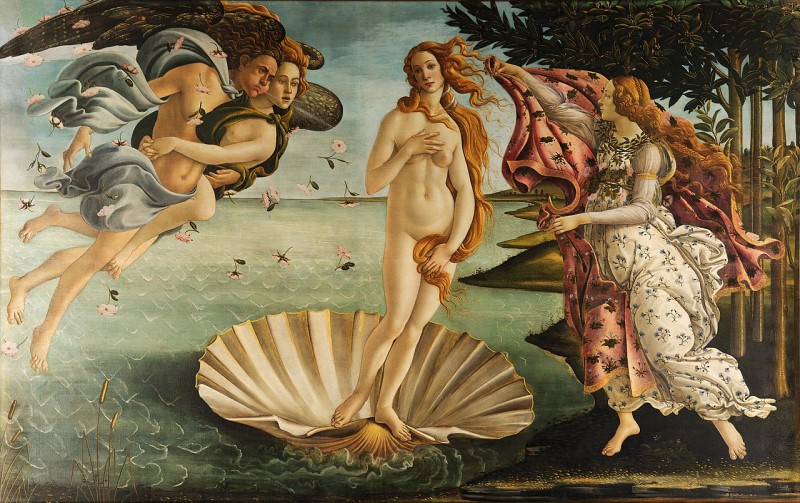
The Birth of Venus (1485) celebrates a key moment in Greek mythology when the goddess of love, sexuality, and beauty is born from the sea. Here Botticelli pushed the boundaries of Renaissance art (and what was culturally acceptable his contemporaries) by glorifying not only the dazzler of the homo body, but by openly celebrating Venus'due south sexuality. The painting thus completely rejected the asceticism associated with Christian piety during the Middle Ages, suggesting instead a kind of joyful sensuality.
Despite paintings like The Birth of Venus, all the same, Botticelli remained a pious Christian throughout his life. In 1490 Botticelli fell under the influence of Girolamo Savonarola, a peppery preacher who came to Florence to denounce its "vanities" (art, rich dress, and general worldliness) and phone call for a strict, even fanatical form of Christian beliefs. While in that location is no tangible testify to back up the claim, some stories had it that Botticelli even destroyed some of his own paintings under Savonarola'southward influence. While Savonarola was executed in 1493, Botticelli did not go on to produce art at the same footstep he had before the 1490s. By then, of course, he had already clinched his identify in art history as one of the major figures of Renaissance painting.
Leonardo da Vinci (1452 – 1519)
Da Vinci was famous in his ain time as both one of the greatest painters of his age and as what we would at present telephone call a scientist – at the time, he was sought later for his skill at engineering, overseeing the construction of the naval defenses of Venice and swamp drainage projects in Rome at unlike points. He was hired by a whole swath of the rich and powerful in Italy and France; in his erstwhile age he was the official chief painter and engineer of the French male monarch, living in a private chateau provided for him and receiving admiring visits from the king.
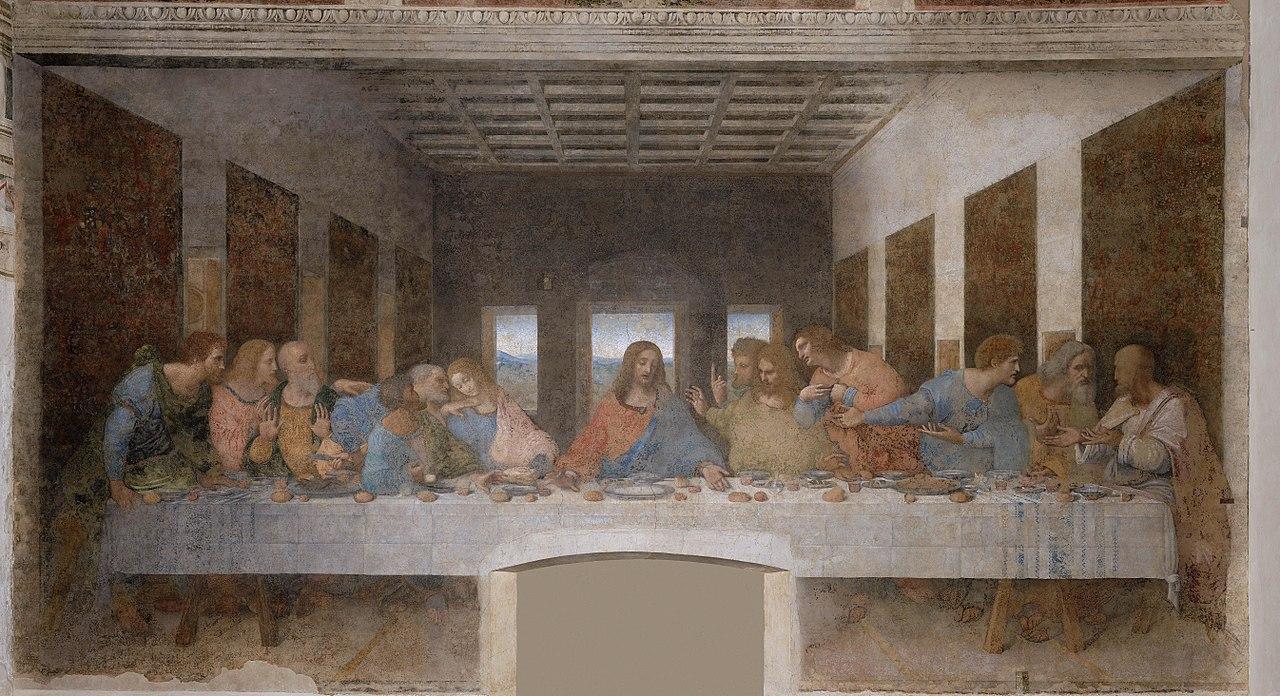
Leonardo Da Vinci'south The Last Supper. Note how the walls and ceiling tiles announced to slant downwards toward a point at the horizon behind Jesus (in the heart). That imaginary bespeak – the "vanishing betoken" – was one of the major creative breakthroughs associated with linear perspective pioneered past Brunelleschi.
Leonardo's scientific piece of work was often closely related to his artistic skills. While the practice of autopsy for medical knowledge was cipher new – doctors in the Middle East, Northward Africa, and Europe alike had used autopsies to further medical knowledge for centuries – Leonardo was able to document his findings in meticulous detail thanks to his artistic virtuosity. He undertook dozens of dissections of bodies (most of them executed criminals) and drew precise diagrams of the parts of the body. He also created speculative diagrams of various machines, from practical designs like hydraulic engines and weapons to fantastical ones like flight machines based on the anatomy of birds.
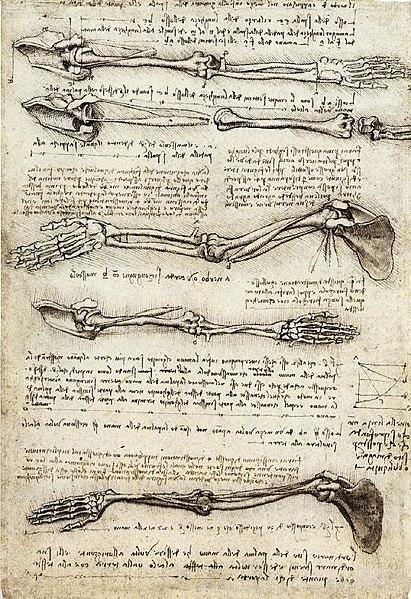
One of Da Vinci's anatomical sketches, in this case examining the skeletal structure of the arm.
Da Vinci is remembered today thanks every bit much to his diagrams of things like flying machines every bit for his fine art. Ironically, while he was well known as a practical engineer at the time, no one had a clue that he was an inventor in the technological sense: he never built physical models of his ideas, and he never published his concepts, and so they remained unknown until well after his death. Likewise, while his anatomical work predictable important developments in medicine, they were unknown during his own lifetime.
Michelangelo Buonarroti (1475 – 1564)
Michelangelo was the almost historic artist of the Renaissance during his ain lifetime, patronized by the city council of Florence (run by the Medici) and the pope alike. He created numerous works, most famously the statue of the David and the paintings on the ceiling of the Sistine Chapel. The latter work took him 4 years of piece of work, during which he argued constantly with the Pope, Julius 2, who treated him like an artisan servant rather than the truthful artistic genius Michelangelo knew himself to exist. Michelangelo was already the most famous creative person in Europe thanks to his sculptures. By the time he completed the ceiling of the Sistine Chapel, he had to exist accepted every bit 1 of the greatest painters of his age besides, non just the single most famous sculptor of the time.
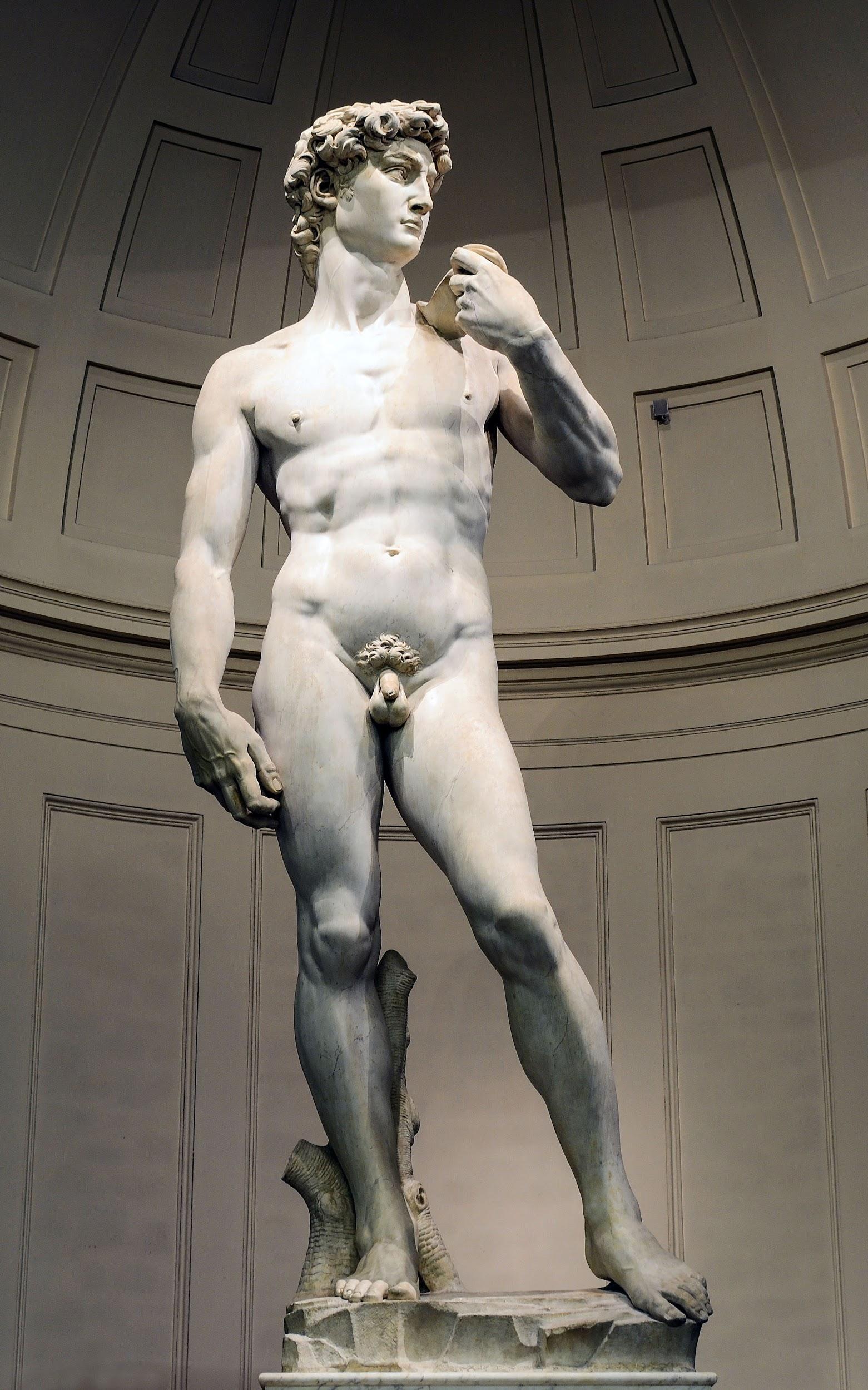
Michelangelo'southward David, completed in 1504 (it took three years to consummate). The statue was meant to celebrate an ideal of masculine dazzler, inspired past the example of Greek sculpture and by the work of an before Renaissance creative person, Donatello.
In the end, a biography of Michelangelo written past a friend helped cement the idea that there was an important distinction betwixt mere artisans and truthful artists, the latter of whom were temperamental and mercurial but possessed of genius. Thus, the whole thought of the artist as an ingenious social outsider derives in part from Michelangelo's life.
Conclusion
Renaissance fine art and scholarship was enormously influential. While the process took many decades, both humanist scholarship and pedagogy on the one mitt and classically-inspired art and compages on the other spread beyond Italia over the course of the fifteenth century. Past the sixteenth century, the study of the classics became entrenched as an essential office of elite instruction itself, joining with (or rendering obsolete) medieval scholastic traditions in schools and universities. The beautiful and realistic styles of sculpture and painting spread likewise, completely surpassing Gothic artistic forms, just as Renaissance architecture replaced the Gothic style of edifice. Along with the political and technological innovations described in the post-obit capacity, Renaissance learning and art helped bring about the definitive end of the Middle Ages.
Image Citations (Artistic Commons):
Cosimo de Medici – Public Domain
Printing Press – Graferocommons
Florence Cathedral – Creative Commons, Petar Milošević
Adoration of the Magi – Public Domain, The Yorck Project
Nascence of Venus – Public Domain
The Terminal Supper – Public Domain
Da Vinci Anatomical Drawings – Public Domain
The David – Creative Commons, Jörg Bittner Unna
Source: https://pressbooks.nscc.ca/worldhistory/chapter/chapter-3-the-renaissance/
0 Response to "Why Was Italy and to More Detailed Extent Venice and Florence Primed for Funding the Arts"
Post a Comment